Our top pick586 reviews
3.5 hAirplane Skydiving over the Swiss Alps
★ 4.9 · 586 reviews
- 3.5 hours, Freefall over the Swiss Alps
- Instructor, gear and briefing
- Longest flight here
- Free cancellation
$526$150.29 / hour
Check availability→ Photos & video
The one line worth reading before you book: the camera is not in the fare. Your tandem master wears a handcam on the wrist, films the whole jump from the door to the landing field, and the photos and video are paid for separately on site — the price is quoted at the airfield in Reichenbach, not on the booking page. The jump itself, $526, includes the skydive, the safety briefing, the equipment and the tandem master. This page explains what the handcam actually captures, what the four inclusions do and do not cover, and how to decide about the media before the bus leaves Interlaken.
Quick answer
The short answer. Yes, your Interlaken skydive can be filmed, and yes, you pay for it separately. The tandem master wears a handcam on the wrist: no second jumper flies alongside you, the camera comes out of the same aircraft on the same arm that is holding you, and it films from the moment the door opens until your feet touch the grass at Reichenbach. The four things named in the fare on $526 are the skydive, the safety briefing, the skydiving equipment and the tandem master. Photos and video are not among them. They are offered at the airfield and charged on site, and the price is the one quoted there — the listing publishes no figure, so neither do we. Bring a card or cash, decide before you board rather than after you land, and tell your instructor at the briefing that you want the handcam running.
The thing people find out too late
There is a moment that repeats itself on every skydiving airfield in the world, and Reichenbach is no exception. Someone lands, unclips, walks back across the grass grinning, and then asks the question they should have asked an hour earlier: so where is my video? The answer is that filming is arranged and paid for at the airfield, and if nobody asked for it before the aircraft climbed, there is nothing to hand over. It is not a trick and it is not hidden — it is simply not part of what you bought online, and the booking page never claimed otherwise. It only feels like a surprise because most people never read the inclusions line by line.
So read it here instead. The inclusions on $526 are four items, and they are worth knowing by heart: the skydive itself, the safety briefing, the skydiving equipment, and the tandem master. That is a complete jump. Harness, altimeter, the parachute system, the briefing that tells you how to arch and how to lift your legs for landing, and the qualified person who is attached to you from the door to the ground. One instructor per customer, which is how tandem skydiving works and why the day is structured around pairs rather than groups.
What is not in that list is a camera. No stills, no video file, no edit. The media is a separate product sold at the airfield, and the reason it works that way is the way the filming is done: your instructor wears a handcam on the wrist, and switching it on is a decision made before you walk to the aircraft, once you have said yes and settled it on the spot.
We are deliberately not printing a price for the media package anywhere on this site. The GetYourGuide listing does not publish one, and a number invented for a guide page would be worse than no number at all — you would budget around it, and then the figure at the desk would be different. What we can tell you is the shape of the decision: it is made at Reichenbach, it is charged on site, and it is quoted to you before you buy. Ask at check-in, hear the figure, and choose with the real number in front of you rather than one you read on the internet.
The practical takeaway is small and it costs nothing: decide on the ground. People who plan for the media in advance come away with the footage and a story. People who have not thought about it at all get asked at a moment when they are already thinking about the aircraft, say no by reflex, and then spend the bus ride back wishing they had said yes. Forty-five seconds is a long time to remember and a short time to live through, and the handcam is the only thing that brings any of it back in a form you can show someone.
The handcam
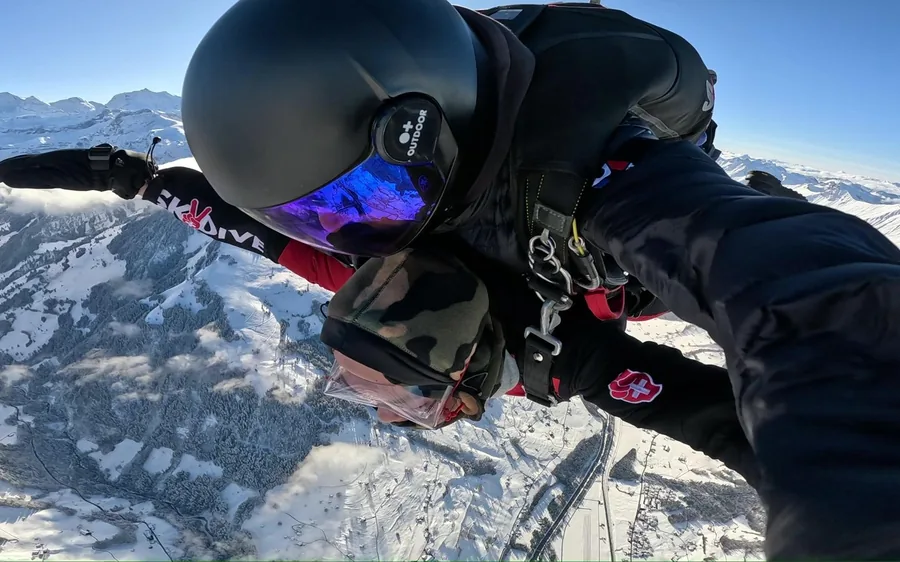
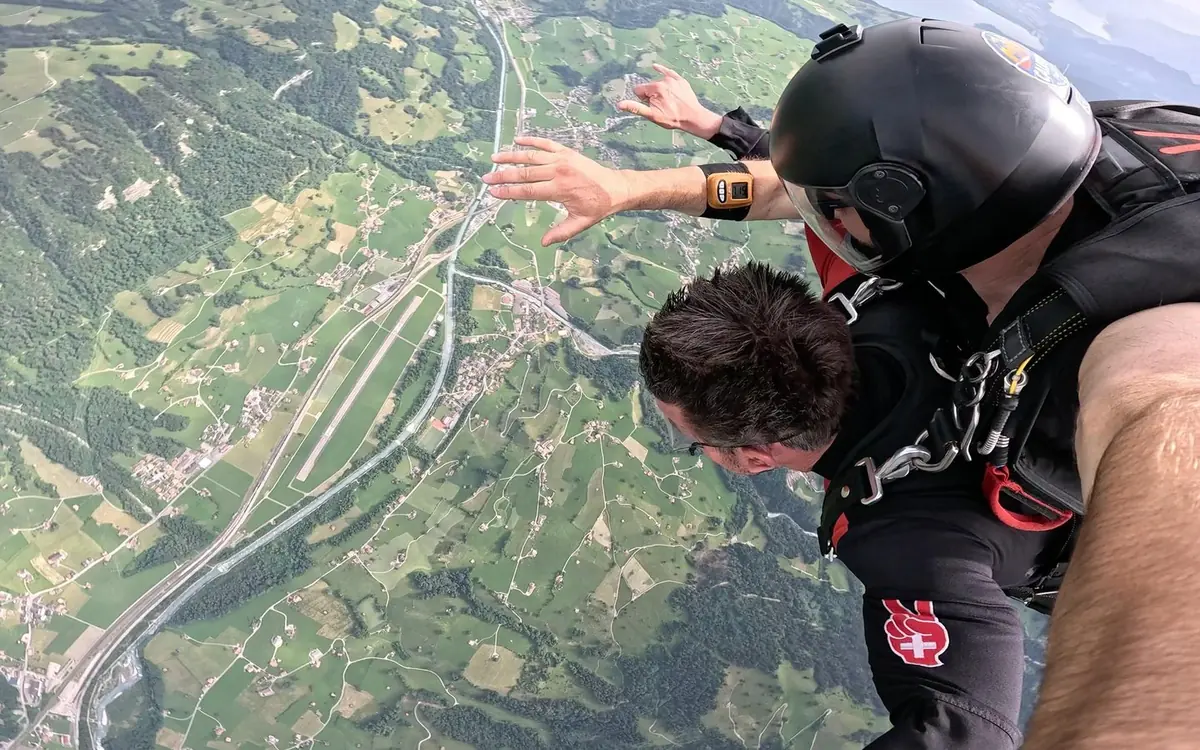
A handcam is exactly what it sounds like: a small camera strapped to the instructor’s wrist or the back of the hand, aimed along the arm. On a tandem jump that geometry does something no other mount can. The instructor is behind you and attached to you, so an arm extended forward puts the lens about where a friend holding out a phone would be — which means the frame is your face, with the Swiss Alps filling everything behind it. That is the shot people actually want. Helmet cameras look at the horizon; the handcam looks at you.
In the aircraft. The climb is the part nobody expects to enjoy on film and everybody watches twice. The camera is running while the aircraft spirals up to 4,000 metres, so you get the window, the valley shrinking, the mountains coming level with the fuselage, and the faces of everyone else on board. Instructors tend to use this stretch to talk to the camera and to you, which is why the footage has a conversation in it rather than just noise.
The door. This is the single second that justifies the whole package. The door opens, the sound changes completely, and the handcam is pointed straight at your face as you rock back with your instructor and go. No angle you can arrange yourself captures that, and no memory reproduces it accurately — ask anyone who has jumped what the exit felt like and watch them fail to describe it.
Forty-five seconds of freefall. The listing is specific: a 45-second freefall from 4,000 metres, with the ground coming up at 200 km/h (120 mph). On camera this is the loudest, fastest and least controllable part of the film. Your cheeks move. Your hair does whatever it wants. The Alps rotate behind your head as the instructor steers the fall. Most people find they are grinning in every single frame and had no idea at the time.
The canopy ride. Then the parachute opens and the film changes character entirely: 5 to 7 minutes of quiet, according to the listing, drifting down towards the landing area at Reichenbach with the Bernese Oberland spread out underneath. This is where the scenery footage comes from, and where you get the calm, coherent version of your own face — the one you can actually hear talking. Instructors often turn the canopy here so the camera picks up the peaks on one side and the valley on the other.
The landing. Legs up, a slide onto the grass, and the walk back with the harness still half-on. The last twenty seconds of a handcam file are usually the most-watched part after the exit, because it is the only footage of what you look like immediately after doing something you had been thinking about for months.
Two practical notes about the handcam, both worth knowing before you book. First, it is a single camera on a single arm: there is no separate camera flyer filming you from the outside, so the whole film is shot from your instructor’s point of view. Second, stills and video usually come off the same footage, so a “photo package” on a handcam jump generally means frames pulled from the film rather than a separate stills session. Ask at the airfield which formats you are being offered and how the files are delivered before you pay — the answer is the operator’s to give, and it is given on the spot.
The fare
Read the left column as the complete list of what you have already paid for. The right column is the conversation that happens at check-in in Reichenbach.
| Item | In the fare? | Where it is settled |
|---|---|---|
| The skydive45 seconds of freefall from 4,000 m | Yes — named in the inclusions | Booked online |
| Safety briefingHow to arch, how to land | Yes — named in the inclusions | At the airfield, before you fly |
| Skydiving equipmentHarness and parachute system | Yes — named in the inclusions | Fitted for you at the airfield |
| Tandem masterOne instructor per customer | Yes — named in the inclusions | Assigned at check-in |
| Handcam videoFilmed from your instructor’s wrist | No — charged on site | Price at the airfield in Reichenbach |
| PhotosUsually frames from the same footage | No — charged on site | Price at the airfield in Reichenbach |
| Seat on the bus from InterlakenMeeting point on Höheweg | For jumpers only | Companions travel to Reichenbach themselves |
| Free cancellationShown on the booking page | Yes — on the booking page | Before you travel |
Book direct
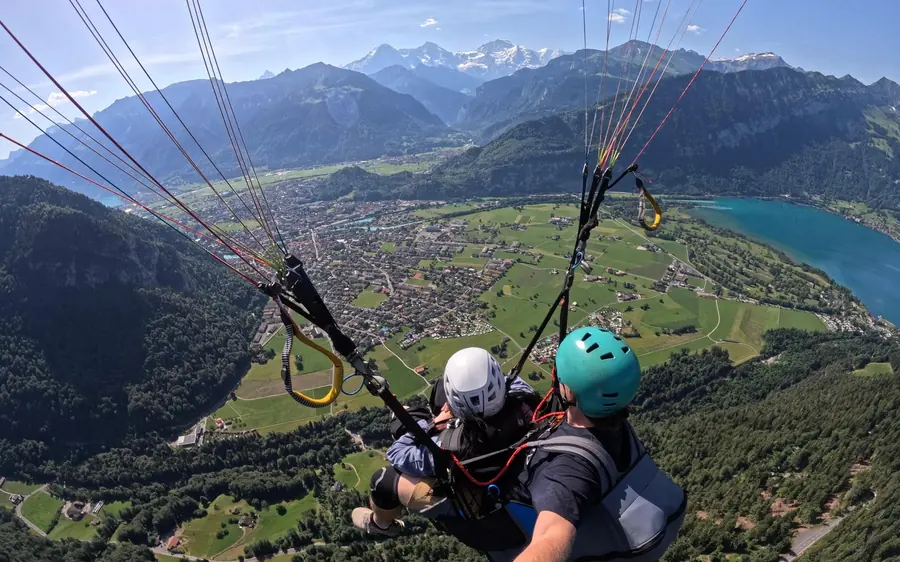
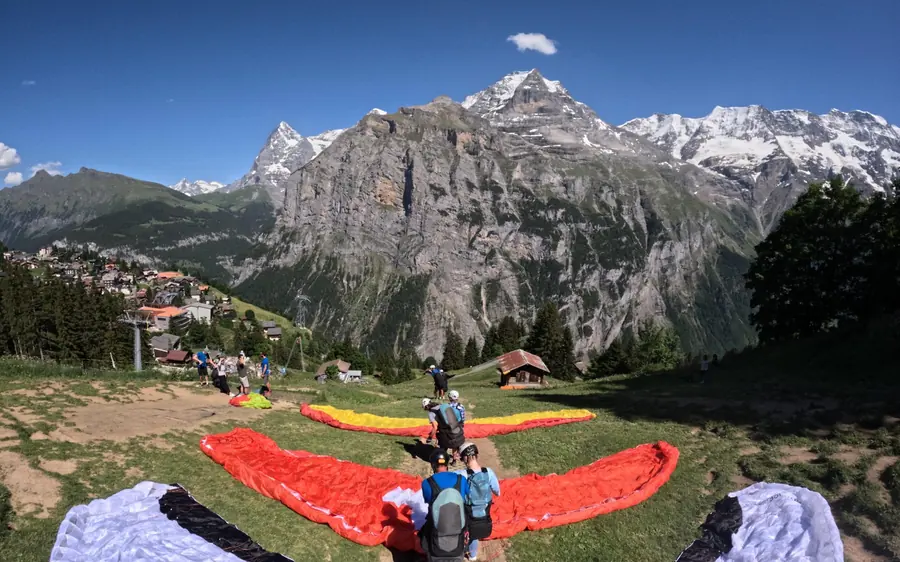
The one airplane skydive on this site, the most reviewed tandem flight above Interlaken, the launch over the Lauterbrunnen cliffs, and the only listing whose inclusions name a camera.
★ 4.9 · 586 reviews
★ 4.9 · 2,580 reviews
★ 5.0 · 367 reviews
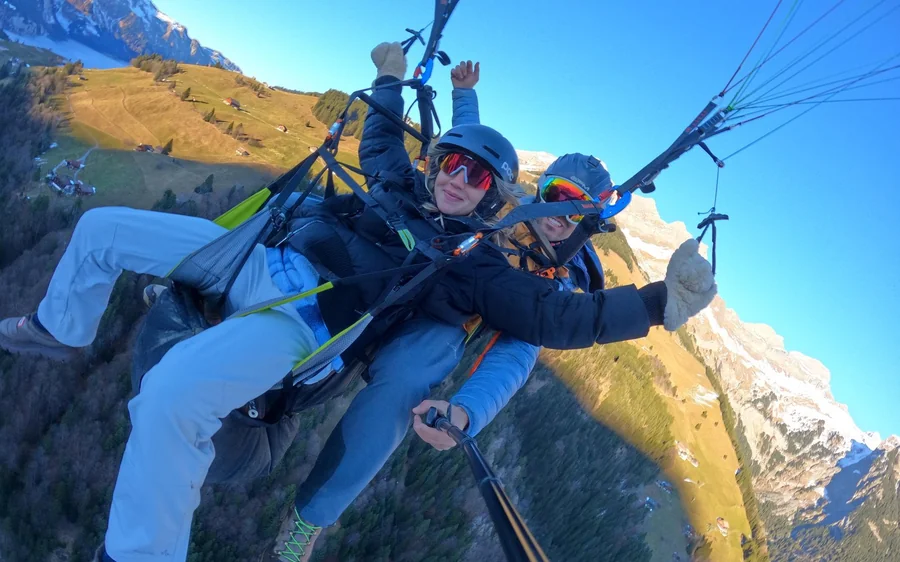
★ 4.9 · 24 reviews
The verdict
If this is your first jump: take the handcam. The first one is the one you will talk about, and it is the one you remember least accurately, because the exit removes your ability to take notes. 586 people have rated $526 and it holds 4.9 — a lot of those reviews are people describing the footage, not just the fall. Say yes at check-in in Reichenbach, hear the price there, and have a card ready.
If you want the face shot specifically: the handcam is the only mount that gives it. Your instructor’s arm is the camera position, so the frame is you with the Alps behind you, from the door onwards. There is no outside camera flyer on this jump, so if you skip the handcam there is no footage of you at all — only what the people on the ground can see, which at 4,000 metres is nothing.
If you are flying as well as jumping: check each listing separately. The media arrangement is set by each operator, and only one listing on this site names a camera in its inclusions: $272, whose inclusions read “tandem gear and camera”. Everywhere else, including $222 with its 2,580 reviews and $209 over the Lauterbrunnen cliffs, treat photos and video as a separate question to ask your pilot on the day.
If you are bringing your own camera: ask first, and expect the answer to be about mounts. Anything in your hands is something you are not using to hold your harness, and anything strapped on is equipment the instructor is responsible for. The person to ask is your tandem master at the briefing, and the answer you get at the airfield is the one that counts.
If you are travelling with someone who is not jumping: plan their transport first. The bus from Interlaken carries jumpers only. Companions get themselves to Reichenbach, and once they are there they are the second camera — the landing area is where the canopy comes in, and that is the shot the handcam cannot take.
Getting there
Seven steps, and only two of them involve a decision. Step three is the one this page exists for.
| Step | What happens | What to watch for |
|---|---|---|
| 1. Meet in InterlakenOutdoor Höheweg Shop, Höheweg 95 | Check in at the shop in town at the time on your booking | The bus seats are for jumpers; companions make their own way |
| 2. Drive to ReichenbachAbout 30 minutes | The airfield and the landing area are both at Reichenbach | Allow for the drive in both directions when planning the day |
| 3. Decide about the mediaAt the airfield desk | Photos and video are offered and charged on site | The price is quoted there; bring a card or cash |
| 4. Safety briefingNamed in the inclusions | How to arch, where to put your legs, how the landing works | Tell your instructor here that you want the handcam running |
| 5. Gear up and boardEquipment and tandem master included | Harness fitted, one instructor per customer | The camera is on your instructor’s wrist, not on a helmet |
| 6. Jump45 seconds, then 5–7 minutes | Freefall from 4,000 m at 200 km/h, then the canopy ride down | Look at the hand: that is where the lens is |
| 7. Collect the filesBack on the ground at Reichenbach | The operator hands over the footage as agreed at step three | Ask how delivery works before you pay, not after you land |
When to go
The jump runs through the year and the handcam does not care about the calendar. What changes is what is behind your face in the frame.
Jun–Aug
Long days, the most jump slots and the greenest valley under the canopy. The busiest window for $526, and the one where a late afternoon slot puts low sun across the peaks in the last minutes of the film.
Sep–Oct
The clearest air of the year and the colour changes in the valley below Reichenbach. Strong weeks for the canopy footage, and for pairing the jump with $209 over the Lauterbrunnen cliffs.
Apr–May
Snow still on the high peaks, green already in the valley, and fewer people at the airfield. The most contrast the Alps ever put behind your face in a handcam frame.
Nov–Mar
Short days and a white landscape. Fewer slots, quieter check-in, and a completely different film — $222 and $259 fly through the cold months too, with their own arrangements for photos.
Mistakes
All six are settled before you board the bus in Interlaken, and all six are free to fix.
The inclusions on $526 name four things: the skydive, the safety briefing, the equipment and the tandem master. The camera is not one of them — photos and video are charged on site.
The media is settled at Reichenbach, not on the booking page. A card or cash in your pocket is the whole preparation, and there is no price published in advance to plan around.
The handcam has to be running during the jump. Once you are back on the grass the decision has already been made for you, and it was no.
This is a handcam jump: the camera is on your instructor’s wrist and the film is shot from their point of view. That is what gives you the face shot from the door onwards.
On a handcam jump, stills usually come off the same footage. Ask at the desk exactly which formats you are being offered and how the files reach you.
The bus from Interlaken seats jumpers only, and your companion travels to Reichenbach independently. Worth arranging the day before rather than at the meeting point.
Checklist
Five lines, and nothing about the day is a surprise.
Photos and video are charged on site at Reichenbach and the price is quoted there. Card or cash, either way, in a pocket you can reach.
Yes or no to the handcam, decided in town rather than in the thirty seconds before the briefing.
The skydive, the safety briefing, the skydiving equipment and the tandem master — the four inclusions on $526, 586 reviews at 4.9.
The bus carries jumpers only. Whoever is coming to watch the landing makes the 30-minute trip themselves.
Shown on the booking page, and worth having on a day that depends on the weather over the Bernese Oberland.
One airplane skydive over the Swiss Alps, $526 — 45 seconds of freefall from 4,000 metres, a 5 to 7 minute canopy ride, and 586 reviews at 4.9. Photos and video are filmed on your instructor’s handcam and charged on site.
See the jump and the flights→Common questions
No. The inclusions on $526 are the skydive, the safety briefing, the skydiving equipment and the tandem master. Photos and video are offered separately and charged on site at the airfield in Reichenbach, where the price is quoted to you. The listing does not publish a figure in advance, so we do not print one.
It means the camera is worn on your tandem master’s wrist rather than on a helmet or carried by a separate camera flyer. Because your instructor is attached behind you, an extended arm points the lens at your face with the Alps behind it, which is why handcam footage is mostly you rather than mostly horizon.
The price is the one quoted at the airfield. It is charged on site and the GetYourGuide listing does not publish it, so the honest answer is to ask at check-in in Reichenbach and hear the real figure. What is fixed in advance is the jump itself, $526 for 3.5 hours including the briefing, the equipment and your tandem master.
The climb to 4,000 metres, the door opening, the 45-second freefall at 200 km/h (120 mph), the 5 to 7 minute canopy ride down over the Bernese Oberland, and the landing at Reichenbach. On a handcam the whole thing is filmed from your instructor’s point of view, so your face is in frame from the exit onwards.
That is a question for your tandem master at the safety briefing, and the answer given at the airfield is the one that applies. The filming this operator offers is the handcam on the instructor’s wrist, arranged and paid for on site.
Each listing sets its own arrangement. On this site only $272 names a camera in its inclusions, which read “tandem gear and camera”. For $222, $234, $209 and the rest, ask your pilot on the day — their inclusions list the flight, the pilot and the equipment rather than media.
Go deeper
The airplane jump over the Swiss Alps, what the day looks like and what it costs.
What it costsThe fare, what is included and what photos and video add.
Helicopter jumpWhat people mean by a helicopter jump here, and what is bookable.
Over the AlpsWhat you see from altitude: the Jungfrau wall, the lakes and the valley.
Your first jumpFrom check-in to landing, minute by minute.
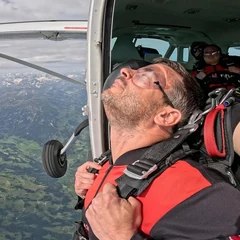
Airplane Skydiving over the Swiss Alps
★ 4.9 · 586 reviews · Free cancellation 24 h